Showing posts with label jewish interest. Show all posts

Thursday, June 8, 2023

Review: One Hundred Saturdays, by Michael Frank


One Hundred Saturdays: Stella Levi and the Search for a Lost World
, by Michael Frank. Memoir. Avid Reader Press, 2022.

One Hundred Saturdays is composed of 100 chapters representing a series of interviews writer Michael Frank conducted with Stella Levi, a nonagenarian New Yorker, formerly of a Jewish community based in Rhodes, Greece. Through the 100 chapters Michael lets Stella tell the story of her life- the community she grew up in, how it was impacted by World War 2, German occupation and its dissolution as the Jewish residents were deported en masse to Auschwitz. He follows her through the camps and finally to the United States, where she makes a life first in California and then in New York.

The book is peppered with illustrations by the great Maira Kalman which give the story an otherworldly feel. Frank extracts Levi's story piece by piece and succeeds in bringing it to life beautifully. We learn about the culture, traditions, languages and food of this varied and vibrant community. It proceeds more or less chronologically and we are treated to a really colorful story of a community lost to history. Her time in the camps is haunting, and her road to a new life in the United States is fascinating. The book is also a testament to the friendship and trust that Levi and Frank built. It reminds me a little of Lucette Lagnado's The Man in White Sharkskin Suit, a first-person memoir of growing up in Cairo around the same time, but this book has the added nuance of the interview-interviewee relationship and rapport.

I would definitely recommend this to anyone interested in Jewish history, particularly Sephardic history, or in any of the many ways that World War 2 impacted people all over the world. It's a fascinating and moving portrait of a life and a lost world.

FTC Disclosure: I received an ARC of this book from the publisher.

Wednesday, April 26, 2023

Review: How America Changed Yiddish, and How Yiddish Changed America, by Ilan Stavans


How Yiddish Changed America, and How America Changed Yiddish,  edited by Ilan Stavans and Josh Lambert. Restless Books, 2020. Nonfiction.

If you are at all interested in the history of the Yiddish language this book is required reading.

We begin with the language as it originated in Europe- its origins and components, and then how it traveled to the Americas with the waves of immigrants and spread across the continents. The book covers its evolutions and uses in media, theater, literature and everyday life, including the ways it's still growing and changing. The book also covers the various efforts to document, preserve and standardize the language and literature in the modern era. Readers will learn about playwrights, musicians, actors, activists, labor movements, writers, linguists, book collectors, preservationists and ordinary people who keep the language alive. Communities from Brooklyn to Havana to Argentina get covered. It's really just chock full of information.

The book is full of excerpts from various works to illustrate the history, growth and ongoing power of the language and the culture around it. I read the book on audio and I would recommend you do it in print unless you must do books in audio (which is fine, it's still reading) only because it's basically an anthology peppered with narration and exposition, and the excerpts, which are plentiful and fascinating, would probably work better in print for most readers. But if you're an audio person knock yourself out.

I'm planning to buy a print copy for my own library and I really recommend it highly to anyone interested in the subject at all.


FTC Disclosure: I did not receive a copy of this book for review.

Thursday, April 20, 2023

Review: Ariel Samson: Freelance Rabbi, by MaNishtana


Ariel Samson: Freelance Rabbi by MaNishtana. Published 2018 by Multikosheral Press NYC. Fiction.

Ariel Samson: Freelance Rabbi is a novel by and about a Black Orthodox Jewish rabbi living in Brooklyn, and it is pretty great.

It's set in the Midwood and Flatbush neighborhoods of Brooklyn as well as around Manhattan. So it's a very New York book. As the book opens Ariel has, though a series of circumstances, come to be the rabbi of a small and dilapidated shul, and he navigates and negotiates the community it attracts alongside his own complicated social and romantic life.

I enjoyed the heck out of this book. The narrator, who is not Ariel but someone else, is funny and fierce and unique. I don't think I've encountered its like before but the novel is not exclusively voice-driven. It works on a number of levels with richly drawn characters, a vivid setting and enough plot to keep us going especially as the book rounds the corner into its final quarter. I enjoyed how well he brings us into Ariel's world, how immersive the book is and how easy it is to find one's way around as a reader. He does a great job of dramatizing the back-and-forth inside of Ariel as well as all the drama swelling around him. And there is a lot of drama.

I also liked how the author balances action and drama with introspection. And I want to know more about the narrator, who seems to be a bystander of some kind. Maybe I missed it but I don't think we ever find out their identity. It's not a third-person omniscient; this person has an identity and a role to play in the story. Maybe we'll learn more in a sequel or in something else by MaNishtana in the future.

I'd recommend it to just about anyone. Go order it from Bookshop and read it please.


FTC Disclosure: I did not receive this book for review.

Tuesday, April 4, 2023

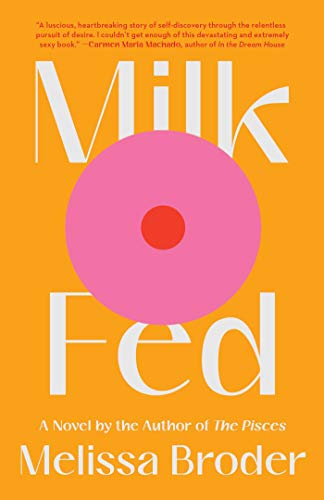
Review: Milk Fed, by Melissa Broder


Milk Fed, by Melissa Broder. Published 2021 by Scribner. Fiction.

I'm a big fan of Melissa Broder and her books tend to be of a type, so if you like one you will like the others. The others are The Pisces, a 2019 novel about a woman who falls in love with a merman, and So Sad Today, her 2016 collection of essays.

Milk Fed is about a young woman living in Los Angeles, Rachel, who is hungry. She is hungry for food; she counts every calorie, obsesses over every bite, every morsel of food. She is hungry for love as well, and for a time she can satisfy both hungers with Miriam, a young woman who works in a frozen yogurt shop. Rachel becomes passionately attached to Miriam who is both very religious and possibly very straight. Or maybe not. But anyway things don't really go well here.

Milk Fed is a lot messier than The Pisces, emotionally and viscerally messy in a way that might be a little much for some readers. Rachel is not totally likeable in the sense of being virtuous but I do think she is very real and relatable if exaggerated maybe. She projects her own desires onto Miriam the zaftig gourmand, but she is expelled from her paradise eventually and must deal with her own issues sooner or later.

I loved this book like I do all of Broder's books, for that mess, that realness, that raw portrayal of female passion. The book has a lot of graphic sexual content that may not be for all readers.  I read this a while back, not long after it came out, during the period of time when I wasn't blogging and it was one of the books that made me want to return so I could talk to you about it. (I got a galley somewhere, maybe at work.) I recommend it to readers of Lisa Taddeo, Kristin Arnett, Ottessa Moshfegh and Alissa Nutting especially. Worth a look if you're up for something different.


FTC Disclosure: I did not receive this book for review.

Tuesday, March 28, 2023

Review: Jersey Breaks, by Robert Pinsky


Jersey Breaks: Becoming an American Poet, by Robert Pinsky. Published 2022 by W.W. Norton & Company. Memoir.

For those of you who don't know Robert Pinsky he is a former U.S. Poet Laureate and taught at Harvard and Wellesley, among other places. I sort of got to know about him in the 1990s and 2000s as a public figure around Cambridge, Mass. And now I live in New Jersey so it's fun to read about his life here and get a sense of history.

He grew up in New Jersey in a colorful, diverse community and the book covers his life in non-chronological form, mostly about his growth as a writer and poet and his career in academia. I actually forgot that he taught at Wellesley at one point (where I went to college) so it was fun to rediscover that and hear about the community of writers in and around Cambridge in the 1970s-1990s or so. 

The book is a relatively quick read; I was reading two chapters a night but after about the middle of the book I slowed down because I was enjoying his voice so much. It feels like he is chatting to you. He is such a good writer and the book is immersive and pulls the reader along with its current. I felt like I got a good sense of the things pushing and pulling him in different directions, his influences both literary and familial. His personal life takes a back seat here at least after his childhood, which he narrates vividly.

Over all it was a really satisfying read and I could even see re-reading it at some point which I seldom if ever do with nonfiction. It does also make me want to seek out his poetry. Highly recommended.

Tuesday, January 17, 2023

Review: Jewish Literature: A Very Short Introduction, by Ilan Stavans

Jewish Literature: A Very Short Introduction, by Ilan Stavans. Published 2021 by Oxford University Press.

This is a book that does what it says on the label. It provides a very short introduction to Jewish literature. The book, pocket sized and clocking in at about 116 pages of text, is broken up into chapters covering various areas of Jewish fiction and nonfiction, more or less chronologically starting with the expulsion of the Jews from Spain in 1492. Stavans is a professor at Amherst and a scholar with deep knowledge of his subject; I encountered this book as a part of a course I'm taking with him on early Jewish literature but this book covers pretty much everything. (He also wrote the book I've been listening to for a while, How Yiddish Changed America and How America Changed Yiddish, which goes into much much more depth on Yiddish literature.)

His voice is engaging and while the book feels like a big checklist, it's never dull or dry. He provides pencil sketches of the lives and works of everyone from Fernando de Rojas through Susan Sontag and I found myself taking notes for things to check out or look for and even though I am not new to the subject I still learned quite a bit. I was particularly drawn to the chapters on translation and criticism as these were not things I expected to read about and found them very interest-piqueing.

The only issue I had is that I felt like there could have been an entire chapter devoted to Russian writers. But maybe you need a whole book for that subject and there are Russians sprinkled throughout in particular in the chapter on people who wrote in Yiddish.

I would definitely recommend this to anyone interested in the subject and I think even if you already know a lot, Stavans provides a pretty broad and wide-ranging panorama and you'll probably find something new and interesting to investigate in your own reading.  It has definitely earned a permanent place on my reference shelf.

Tuesday, January 10, 2023

Early Jewish Literature Class


Today begins my Early Jewish Literature class, run by the YIVO Institute for Jewish Research and taught by Jewish lit A-lister Ilan Stavans. That is a picture of the reading list! The books we will be reading are:

A Very Short Introduction to Jewish Literature, by Stavans,

Lazarillo de Tormes, translated and edited by Stavans,

Celestina, by Fernando de Rojas, 

Don Quixote of la Mancha, by Miguel de Cervantes, which includes Stavans' Introduction, and

Quixote, The Novel and The World, by Ilan Stavans.

First up, appropriately, is A Very Short Introduction, which I've read and will write a review for soon.  We are not reading every page of every book in the three-week course but I'll do as much as I can. I've always wanted to read Don Quixote (and tried and failed once so far) and I'm really looking forward to Stavans' take on the book and the rest, too. Fun!

Monday, November 28, 2022

Jewish Book Month: LGBTQ Rep


Milk Fed, by Melissa Broder. 2021, Scribner.

Milk Fed is the second novel by Melissa Broder, late of The Pisces and the essay collection So Sad Today. It is about a young woman named Rachel, a lesbian with eating disorders and a bad relationship with her mother, who falls for Miriam, a young Orthodox woman who relishes her food but can't quite return Rachel's sexual appetites.

I loved this book the way I loved Broder's other books, for its extreme candor when it comes to women and bodies and sex and this time, food. Rachel meets Miriam at a frozen yogurt bar and is immediately smitten both with Miriam's creativity and relaxed attitude towards food and with her sensual body. Being with Miriam is feast for Rachel, but Miriam hesitates when it comes to fully engaging with Rachel sexually.

The book is raw and explicit when it comes to both Rachel's emotions and her physical and sexual hungers. If you've read Melissa Broder before you know what to expect. I found it to be a moving and intense love story, about the two women and about Rachel's struggle to find balance and acceptance in all areas of her life.

Tuesday, June 28, 2022

Review: More Than I Love My Life, by David Grossman


More Than I Love My Life, by David Grossman. Knopf, 2021. Translated from the Hebrew by Jessica Cohen.

David Grossman is one of my favorite writers; any time he has a new book, I'm in, and I've been working my way through his backlist too. I first read him for a book club I lead for a temple library job; that book was Someone to Run With and I've been a fan ever since. This book centers on three women- Vera, her troubled daughter Nina, and Nina's angry daughter Gili. Vera escaped from Yugoslavia with Nina to Israel and married again after her first husband, her beloved Milosz, died during the war. Gili is a filmmaker and along with her father Rafael, Vera's stepson, the three women journey back to the now former Yugoslavia to learn the truth about their family.

I found Gili to be a singularly unlikable narrator but her personality is convincingly formed by the trauma she was subjected to by her even more traumatized mother. The book is partly about intergenerational trauma, the way that pain is passed from mother to daughter to daughter and the way to heal it. It's also about creating and recording history, the benefits and drawbacks of uncovering family secrets and the redemptive power of love.

I didn't get into this book until about halfway through; Grossman draws his women vividly but it did take a minute for the plot to get going, and I am a plot reader. This is a quiet story, albeit one with a violent storm at its center, about forgiveness and growth and moving forward not despite the pain but with it. It's a small story with a big heart and I recommend it to readers of literary fiction and character-driven stories.

I did not receive this book for review.

Tuesday, February 16, 2016

Review: LEAVING RUSSIA: A JEWISH STORY, by Maxim D. Shrayer

Leaving Russia: A Jewish Story, by Maxim D. Shrayer. Published 2013 by Syracuse University Press. Nonfiction. Memoir.

Leaving Russia is a detailed account of one family's struggle to emigrate from Russia, set in Moscow and elsewhere in the Soviet Union in the 1970s and 1980s.

Full disclosure: I interviewed Shrayer in 2008 when I worked for the Association of Jewish Libraries and featured his collection of short stories Yom Kippur in Amsterdam on their blog and mine; I have since kept in touch with him via social media including Facebook and while I have not met him in person, he is someone I know a little bit and I thought you should know that up front.

Anyway, that aside, I finally got around to reading his memoir recently, and it's pretty excellent, especially for readers interested in Soviet refuseniks and Jewish emigration from the former Soviet Union. The book covers Shrayer's life from his teen years through age 20, when he left with his parents David and Emilia. It's quite a searing portrait both of Soviet life as the Soviet Union was on the verge of collapse and the very daunting struggles of Jewish refuseniks to carve out a life while they waited to leave. He and his family live at the mercy of a capricious bureaucracy capable of both arbitrary and systemic antisemitism. They find community with other refuseniks but Shrayer lives a double life, a good student and ordinary kid outside the home, and a persecuted rebel at home. And then there are the times when his two lives overlap.

He writes with great affection about his friends and especially his family. The love he has for his parents radiates from the pages. He clearly idolizes his father, a fellow writer and his role model in so many parts of his life. And his admiration for his mother and her sacrifices, including the physical danger she has from time to time put herself in to support their refusenik cause is also quite palpable. He also shares the vivid world of the friendships and adventures that sustained him and have stayed with him. At the same time there is no doubt that the USSR was a hostile place for him and his family.

I enjoyed reading Shrayer's book a lot for both the refusenik story and the details about Soviet life it offers. This is after all a disappeared world, and I would place it alongside the other leaving-the-USSR memoirs I've read, like Elena Gorokhova's Mountain of Crumbs and Tina Grimberg's Out of Line. As a story about Jewish emigration Shrayer's story has more in common with Grimberg's but Grimberg's book was written for a middle-reader audience while Shrayer's book is unambiguously written for an adults. That said, I don't think there's anything inappropriate for a teen reader interested in the subject of the refusenik movement. It's a very moving, detailed and fascinating story about one family's experience of something that happened to so many families, as well as one young man's coming of age.

And on a personal note, as a Cold-War-era kid I will say that until I started working in synagogues I was completely unaware of the extent to which the story of Soviet dissidents was the story of Jewish people who wanted to leave due to antisemitism. For some reason this "detail" was left out of my public-school education, and I would therefore recommend this book very highly to anyone else who doesn't know very much about this subject, regardless of background. It may seem like a "niche" issue but it really isn't, because it's about the big issues of freedom and the power of the imagination to shape the world.

This counts towards the Read My Own Damn Books Challenge.

Rating: BUY

FTC Disclosure: I did not receive a copy of this book for review.

Friday, January 15, 2016

Jewish Book Carnival!

I'm excited to be hosting the Jewish Book Carnival this month. The Jewish Book Carnival was started in 2008 when then-AJL Vice President Heidi Estrin wanted a community-building regular activity to help bloggers who wrote about Jewish books to come together, share posts and get to know each other, while promoting Jewish literature and authors on the web.

So that said, here are this month's links.

Barbara Krasner and The Whole Megillah start off 2016 with a three-in-one interview with the author, illustrator, and editor of Shmulik Paints the Town. 

Over on the Jewish Book Review, Rivka Levy explores 'Miriam's Song', the true story of a woman who lost two sons in combat in IDF, in one of the most uplifting, inspiring and real books to come out of the Israeli Literary Scene for years.

At Life Is Like a Library, Chava Pinchuck chronicles her day at the National Library of Israel, where she viewed several collections and learned about the resources available in English.


Deborah Kalb interviews a wide variety of authors on her blog, deborahkalbbooks.blogspot.com. She recently spoke with Dawn Lerman, author of the new memoir My Fat Dad: A Memoir of Food, Love, and Family, with Recipes.

The Book of Life offers this interview with Jim Aylesworth (author), Barbara McClintock (illustrator) and Dianne Hess (editor) of My Grandfather’s Coat, picture book winner of the 2015 Sydney Taylor Book Award in the Younger Readers’ Category. The podcast recording includes a bonus track of Jim Aylesworth’s conference session about storytelling!

The Fig Tree Books blog offers a dispatch from the recent Jewish Book Council Jewish Writers' Seminar, with a focus on memoirist Shulem Deen's keynote address.

On My Machberet, Erika Dreifus provides U.S. readers with an sneak peek of Leah Kaminsky's debut novel The Waiting Room, which was published in Australia in September and will be coming to America later in 2016.

Lorri M. Writings brings us a review of The Marriage of Opposites, by Alice Hoffman.

The 2016 Sydney Taylor Book Awards are announced! The award recognizes the best Jewish literature for children and teens. A Blog Tour with the winners will take place February 7-12, 2106!

Batya Medad at A Jewish Grandmother says, I sincerely recommend For Better and For Worse: An Israel Odyssey no matter where you live and no matter what your religion. It gives a very necessary view into the lives and feelings of real Israelis in Judea-Samaria, especially when the international and even local media paint us so badly. And more than that, it is a wonderful story of how idealistic young Jews cope with the reality of life in a very turbulent world. 

Thanks to everyone who participated this month!! Please visit as many as you can and leave comments to let the bloggers know you stopped by.

Thursday, April 2, 2015

Review: THE GERMAN MUJAHID, by Boualem Sansal

The German Mujahid, by Boualem Sansal. Published 2009 by Europa Editions. Translated from the French. Literary Fiction.

If you read about the Holocaust, or Islamic fundamentalism, or France, or immigration, or Algeria, or about people, The German Mujahid is required reading.

Set in modern day France among a French-Algerian-German family, Boualem Sansid's book tells the story of Rachel and Malrich Schiller, born in Algeria to a German father and an Algerian mother. The brothers move to France, and Rachel becomes a successful executive while Malrich flounders  in the banlieue, one of the sprawling suburban high-rise communities filled with the poor encircling Paris. While Rachel assimilates, travels the world and becomes a model citizen, Malrich falls in with the Islamic fundamentalist gang ruling the roost in his housing development.

The narrative is made of excerpts from the two brothers' diaries. When the book opens Rachel is dead. There was a massacre in their Algerian village in which their parents were killed.Their father Hans was an esteemed member of his community, but after his death Rachel finds out that his father was also an escaped Nazi war criminal. Rachel then destroys himself trying to ferret out his father's every last secret, spending the rest of his life learning as much as he can about what his father did and documenting his search in his diaries. He wills his diaries to his brother, whose journals reflect his own torment and struggle to understand what Rachel did, what his father did and how to make sense of his own life.

It's a tough read all around, a really difficult book that will challenge readers' assumptions on many levels. Sansal offers us a glimpse into corners of French life rarely seen and into the hearts of two men who battle conflicts difficult to imagine. The brilliance of this book is how Sansal shows us how hard they fight for air, for understanding and for life even as the tides try to drown them. Rachel didn't make it, but there is some hope that Malrich will. In any case I think this is a really important, powerful book and one everyone should read.

I read it for the 2015 Europa Challenge.


Rating: BUY

FTC Disclosure: I did not receive this book for review.

Wednesday, April 23, 2014

Review: MANNEQUIN GIRL, by Ellen Litman

Mannequin Girl, by Ellen Litman. Published 2014 by Norton.

Kat Knopman starts first grade in September, 1980, in Soviet Russia. Her parents Misha and Anechka are bohemians- beautiful, artistic, sophisticated. Kat is diagnosed with a serious case of scoliosis and has to attend a special school where she has trouble fitting in despite having so much in common with her similarly-situated peers. Her family is Jewish, and this fact presents special challenges within the Soviet system. She struggles with her condition, with the difficulties of boarding-school life and most of all with the gnawing, growing realization that she can never equal her parents and that they might not even deserve the pedestal on which she has placed them.

I am a big fan of Ellen Litman's from her 2008 book of interconnected short stories The Last Chicken in America. This book told the story of another Russian Jew, Masha, only it told her life in America, post-emigration. I loved this book for its psychological insight and lovely prose, and Litman's novel shows the same qualities that made me admire her stories so. In Mannequin Girl, we follow Kat from first grade through the beginning of high school- the changes in her spirit and her body, and the changes in her family's life as well as some of her friends. A boy named Sergei Mironov starts out as her nemesis but becomes something like a friend, her grandfather's young wife gets frozen out, and her parents go from a happy, charmed couple to something more bitter and less sure. Kat burns through an infatuation with a handsome older boy to learn some hard lessons about life.

Mannequin Girl is a slow-moving book that is nonetheless very involving and emotionally touching. Kat is flawed and real and believable, likeable and changeable too. I got involved with her problems, cheered her little victories and suffered her defeats with her. She's an unforgettable character; the book would be a great choice for book clubs as well as suitable for YA audiences. I'm glad this one was classified as adult because being the snob I am I doubt I would have picked it up if it were in the YA section. And then I would have missed out.

Rating: BUY

FTC Disclosure: I did not receive this book for review.

Tuesday, March 25, 2014

Review: THE PALESTINIAN LOVER, by Selim Nassib

The Palestinian Lover, by Selim Nassib. Published 2007 by Europa Editions. Literary fiction. Translated from the French by Alison Anderson.

The Palestinian Lover is a book that keeps me thinking about it long after I closed the final pages. First, there's that title. To what, or whom, does it refer? The book is about a fictional love affair between Golda Meir and an Arab businessman named Albert Pharaon. So maybe it refers to Albert, Golda's Palestinian lover. Or maybe it refers to Golda; the French title is L'Amante Palestinese, amante being the feminine form of the word, and another English translator chose A Lover in Palestine as the title.

Certainly the book is about a woman who loves the land called Palestine, who has come from Europe and America to make a new home there, and for whom a man like Albert represents both the ultimate forbidden fruit and the single thing from which she cannot turn. There's a second woman, too, a Palestinian woman with whom Albert has a relationship after his affair with Golda ends. The book covers time from the early 1930s through 1948 and ranges from a kibbutz to the city but rests largely in the minds of its characters.

Certainly identity and it malleability, the way we put it on like clothes and wear it into the world, is a central theme of the book. Other themes include individual versus group identity, adherence to convention and the power of passion to challenge our ideas about ourselves. The Palestinian Lover also figures as an example of Europa Editions' mission to bring important Arabic literature to Europe and America. Unfortunately it's out of print now but I hope that readers interested in the Middle East and Israel will keep an eye out for this fascinating and important novel.

It's my third for the 2014 Europa Challenge.


Rating: BACKLIST

FTC Disclosure: I did not receive this book for review.

Thursday, March 13, 2014

Review: THE MARRYING OF CHANI KAUFMAN, by Eve Harris

The Marrying of Chani Kaufman, by Eve Harris. Published by Black Cat Press 2014. Literary Fiction.

The Marrying of Chani Kaufman came out in Great Britain last year and was longlisted for last year's Booker Prize. Don't worry though- this is no stuffy "literary" book, although it is well-written, delightful and addictive reading.

Set in the present-day London neighborhood of Golders Green amid its Orthodox Jewish community, the story centers on a 19-year-old young woman named Chani who is about to get married to Baruch, a 20-year-old she barely knows.  As the book opens she's preparing for the nuptials- getting dressed, getting nervous, and he's doing the same. The opening pages capture their anxiety as they shoulder tradition, the expectations of their families and their own innocence, and author Eve Harris conjures this mood so beautifully that these first few pages are what stay most in my mind.

From here Harris shifts perspective to the Rebbetzin, whose husband is the lead rabbi of this particular community. By extension she herself is an important community leader; women come to her for advice and it falls to her to take young Chani to the mikvah, or ritual bath, before her wedding day because Chani's mother is busy with her large brood (Chani is one of eleven children). But the Rebbetzin is deeply conflicted, having grown up secular and then come to Orthodoxy as a young woman when her then-boyfriend committed to a traditional Jewish life. The Rebbetzin has played her role well, admirably even, but now, in midlife and after suffering a traumatic miscarriage, she isn't so sure anymore. Harris takes us through her life's story and into her future.

We get to know Chani and Baruch's families, and see how they interact. Baruch spies Chani at a party and asks to meet her; his mother, a wealthy social-climber, isn't happy that a poor girl has attracted her precious son's attention and schemes to undermine the blossoming relationship. Chani, for her part, isn't sure she even likes Baruch but she knows she has to get married and he seems nice enough so she goes along with it. Ironically it's Baruch's mother's resistance that gets Chani to dig in her heels.

I'm telling you a lot about what happens, so I'll stop. The book isn't perfect; some of the conversations struck me as unrealistic but overall I think The Marrying of Chani Kaufman is a charming and absorbing novel with great characters and a winning couple at its center. I don't think it comes down as very negative about Orthodox life though there are characters who find frustration as their lot. There are also those who will find a way to make it work. The key to happiness, Harris seems to say, is rational balance and finding a partner with whom you are on the same page. Conflict only brings alienation. The book is very heavy on the details of Orthodox ritual and is clear and accessible enough to be a good read for someone interested in learning about that. If you're new to the subject I hope you won't be put off and miss out on this great read.

Rating: BUY

FTC Disclosure: I did not receive this book for review.

Tuesday, January 28, 2014

Review: SAVING MOZART, by Raphael Jerusalmy

Saving Mozart, by Raphael Jerusalmy. Published 2013 by Europa Editions. Literary fiction. Translation.

Saving Mozart is a short, epistolary novel made up of the journals and letters of Otto Steiner, an elderly music critic slowly dying of tuberculosis in a nursing home in Germany between 1939 and 1940. He is a non-practicing Jew and lives in constant anxiety of being found out, but he has a lot of other problems besides that, including deteriorating finances, worsening living conditions, the death of friends and crumbling health. The only thing that keeps him going is music- his records and phonograph, his memories of music and his ability to participate in public musical life.

His friend Hans is his link to the outside world, and when the book opens Steiner is still able to attend concerts and publish articles but over time he becomes more and more isolated. His isolation is reflected conversely in his living conditions; as he becomes more cut off financially and socially from the outside world he transitions from a bed in a single room to one in a shared ward. Introverts like Steiner can be alone in a room full of people and most fully connected to themselves when by themselves.

Above all though Steiner loves music and the music of Mozart most of all. So he is naturally very upset to learn that Mozart's music will be featured at an annual concert that will also function as a propaganda opportunity for the Nazis whom Steiner detests. And so he comes up with a way to make a very public statement at this event, a statement which may go undetected by the very people it was meant to show up, but not by all.

Saving Mozart is a quick read about a topic familiar to many readers but it is an original take on the subject at the same time. I enjoyed the suspense as events lead up to the concert, and the suspense over the changes in Otto's life and fate. It is a moving testimony to an act of rebellion and the refusal of one person to be cowed by or submit to cruelty and horror. Jerusalmy keeps us tottering on a precipice. We know what could happen, what is happening in the background. The musicians play not as Rome burns but as people do.

Rating: BACKLIST

This is my first book for the 2014 Europa Challenge. Want to join?

FTC Disclosure: I received this book for review from Europa Editions.

Wednesday, November 6, 2013

Review: DANIEL STEIN, INTERPRETER, by Ludmila Ulitskaya

Daniel Stein, Interpreter, by Ludmila Ulitskaya. Published 2012 by Overlook. Literary Fiction. Translated from the Russian.

Daniel Stein, Interpreter, is a "novel in documents," a kind of epistolary fictional meditation on the life of a Polish Jew named Daniel Stein who survives the Holocaust and World War 2 by, among other things, translating for the Gestapo. Then during the war he saves the lives of 300 Jews during a raid and eventually becomes a Catholic priest and moves to Israel. Daniel's story is based on that of a real man, Oswald Rufeisen, and while the character Daniel is based on him, Daniel is not he himself. Award-winning Russian writer Ludmila Ulitskaya tells Daniel's story through letters, diaries and official documents and thus the story shifts both in time and perspective. Over the course of the novel connections form between the characters, who seem disparate and diverse at first but who are all connected through a small Polish community torn apart by murder.

The book starts with Ewa Manukyan, a Polish woman searching for information on her father. Her mother Rita is a difficult, unlikeable woman, aging and needy, who had in her youth a reputation as a ferocious soldier. Ewa cannot relate to her at all, and she begins a friendship with Esther Gantman, a wealthy exile living in Boston who, together with her late husband, worked in the Polish ghetto of Emsk during the war. Ewa and Esther's story connects with others, who then connect with Daniel Stein, the enigmatic man at the center of this very complex story.

Brother Daniel's story starts as one of shifting identity. He hides in plain sight by pretending to be Polish; a gifted linguist, he speaks German and Polish fluently and is an accomplished horseman. He works for the Gestapo but tries to undermine them at the same time; he finds both danger and friendship in this life, and has to make heartbreaking choices with consequences that will haunt him for the rest of his life. After the war he establishes a church in Israel that attempts to return to a time before Christianity split from its Jewish founders and then with itself.

In doing so, he steps into the quagmire of Israel's many religious sects and their zealots. He runs afoul of the Catholic Church with some unorthodox preaching and he runs afoul of the state of Israel by asking for Israeli citizenship as a returned Jew. But he has friends. His followers love him; his assistant Hilda, a German woman who has made a home for herself in the desert, would, it seems, follow him to the ends of the earth but her love for him isn't romantic. That she shares with Musa, an Arab Christian who also assists Brother Daniel's ministry. And Brother Daniel has a powerful friend in his boyhood acquaintance Karol, who ascends to the highest office the Church has to offer. Over the years his life intersects with many lives, and Ulitskaya tells their stories alongside his; they embellish each other and create a detailed panorama of life during and after the war.

I loved this book, and so did many, but it has been criticized, too. Some have said that Daniel is a distant figure, that we never get close to him, and because this is an essentially epistolary novel we see Daniel either through the eyes of others as mediated by whatever form Ulitskaya is using, or through his own public statements, so I think that's a valid observation but it doesn't limit the book's power for me. I think she means to hold him at a distance, to make him unknowable even as she meditates on him. The book has also received criticism for its negative portrayal of life in Israel in the years following World War 2- the inflexibility of its government and the fractiousness of its people. I would agree that she does not portray Israel as a paradise but I'm not sure that's a valid critique of the novel as such.

So yeah, I loved it. Reading Ulitskaya is always a treat and unfortunately only four of her many books are available in English. I've read two others and I have the fourth on the shelf. I almost don't want to read it right away because then I'm all out! I loved this book for its characters and the way Ulitskaya unwinds their relationships, and I loved the way they evolve and grow. The characters have distinct voices, problems, perspectives and limitations; Daniel himself lurks in every story even when he's not mentioned explicitly. Ulitskaya uses these other people as lenses through which to see and understand him, to work out what made him tick and how he became this strange and unusual person. And I drank in every word. It's very character-driven as you might guess, very emotional too. Ulitskaya deals with a lot of heavy issues that will raise strong emotions in many readers. As a Catholic with a Pope who seems to value compassion as highly as dogma, it was fascinating to read about a priest similarly inclined, set at a time when religious movements were actively staking claim to land and followers based on dogma. And I want to learn more about Rufeisen, the man behind the story. And I want to read more Ulitskaya. Actually, I can't wait to!

A serious and moving literary novel, Daniel Stein is definitely one of my favorites of 2013.

Rating: BUY

FTC Disclosure: I did not receive this book for review.
Wednesday, September 25, 2013

Review: BETWEEN FRIENDS, by Amos Oz

Between Friends, by Amos Oz. Published 2013 by HMH. Literary Fiction. Short Stories (Interconnected). Translation.

It's been a while since I completed reading a collection of short stories. They have a tendency to gather- they always seem like a good idea- but I usually never get beyond one or two. Not so with Amos Oz's quietly brilliant collection, Between Friends.

Between Friends is set during the 1950s on the fictional Israeli kibbutz of Kibbutz Yekhat, somewhere in the wilds of that young country. Its residents are a mix of young and old, from different backgrounds and experiences. There are young people and old, married couples, single people, parents, children, an orphan.

Kibbutzim (the plural of kibbutz) are collective farms established in the early days of the Israeli state to promote the growth of the country and its agriculture under collectivist principles and are often secular rather than religious in orientation. Kibbutzniks, as they are called, live communally or nearly so, participate in all aspects of running the community including farm work, industrial tasks and whatever else is needed. They are united by their commitment to the kibbutz and the principles that back it. Or at least, that's the theory. Oz shows that there are very distinct individuals running this collective farm, each with his or her own dreams and aspirations, which sometimes conflict with the overall mission of the place.

Oz's series of interconnected short stories focus on characters both at the core of the life of this kibbutz and its periphery. David Dagan is a teacher and ersatz spiritual leader, who tries to maintain the status quo among the people while answering to no one himself. He takes up with a 17 year old former student, much to the chagrin of her father, the kibbutz's electrician. He appears in nearly every story and has a profound influence on the lives of the kibbutzniks. Zvi Provizor is a bachelor in late middle age, works as the kibbutz's gardener and repository of bad news. Osnat deals with her husband's infidelity by writing letters to his lover, for whom he leaves her. Little Oded struggles with bullies and bedwetting and the harshness of collective life for children who don't fit in. Yotam dreams of making a life in Italy with a rich uncle, far from the kibbutz, but he can't quite bring himself to openly rebel. Or can he?

Oz tells the stories of these and other characters with delicacy and beauty. Each story stands on its own but together make for a lovely novel-in-stories about a time and a place that stand alone in recent history. To be honest I could not tell but for the blurb when the stories took place; the where is definite down to the smallest physical details but the lives of the kibbutzniks are disconnected from popular culture or even current affairs, save for Zvi's obsession with tragedies far away. That said, landscape is the real star of this show, both geographic and psychological. I felt like a member of this community by the time the book was finished. Pick it up; you will, too.

Rating: BUY

FTC Disclosure: I borrowed a galley copy of this book from the bookstore.

Thursday, February 28, 2013

Review: JACOB'S FOLLY, by Rebecca Miller

Jacob's Folly, by Rebecca Miller. Published 2013 by Farrar, Straus and Giroux. Literary Fiction.

"I'm a fly on plane.
I've got a lot of dreams.
I never counted on a rolled up in-flight magazz-"
-Christine Lavin, "Fly on a Plane."

You guys. It's early in the year, but I'm ready to add another book to my Best of 2013 list. Rebecca Miller's novel Jacob's Folly comes out next week and I urge you all to race to your independent bookstore and pick it up.

Jacob's Folly has one of the funnest, most original premises I've come across. Jacob Cerf is a dead Jewish peddler from 18th century France come back to life as a fly on the wall- literally- of two modern day New Yorkers. Leslie Senzatimore is an inveterate goody-two-shoes living on Long Island with his family. He's practically a saint, between volunteer fire-fighting and caring for his extended dysfunctional brood, and he drives Jacob crazy with his do-gooder-ness. Enter Masha, an Orthodox Jew with dreams of the stage and screen. She's a beauty with the voice of an angel, and she longs to use her talent the way she believes God intended. Jacob has the power to influence their thoughts and actions, and he uses it.

As we watch these two misfits figure out the meaning of their lives, we also see Jacob's own story unfold, from his disaster of a marriage to his adventures as a peddler, actor and man-about-town.  I think this book would appeal to readers of historical fiction, contemporary family stories and Jewish fiction (obviously). Miller makes Masha's family and beliefs accessible without a deep knowledge of Orthodox practices, and makes Les a complicated man with a deeply troubled past who is nonetheless sympathetic even as he does something truly terrible blinded by desire for Masha.

Miller's writing sparkles at every turn. I can't remember the last time I had this much fun reading a serious literary novel. I did not want to put it down. I think I read it in about four days, shorter than a book of this length would normally take me, because I just didn't want to stop reading it. I had to find out what happened to these people, even to Jacob the fly. I loved it loved it loved it. No that was not a typo. I loved it!

Rating: BUY! Like, now, okay?

FTC Disclosure: I did not receive this book for review.

Tuesday, February 5, 2013

REVIEW: Comedy in a Minor Key, by Hans Keilson

Comedy in a Minor Key, by Hans Keilson. Published 2011 by FSG. Literary Fiction. Translated from the French.

Comedy in a Minor Key is a slender novella about a Dutch couple, Wim and Marie, who hide a Jewish man they know as Nico in their home during World War 2. He's dead. This fact is revealed almost immediately, that he has died while in their protection. The story travels back to his arrival and his stay, then catches up with the present and the consequences for Wim and Marie of Nico's death.

While he's with them, Nico isn't some pale shadow lurking in a closet or a basement. He's part of their day to day lives, and some of their family even know he's there. No blank slate upon which is reflected the goodness of his gentile helpers, Nico is a fully-drawn character with complex feelings towards this couple who are risking their own lives to hide him. He's grateful of course, but he's also miserable, resentful and frustrated. Keilson explores the psychological impact of being hidden on both the hiders and the person hiding, and this exploration takes on an extra dimension when Wim and Marie are forced into hiding themselves.

This novella, a spare and haunting little thing, is a quick read but will still manage to take up a lot of space in your thoughts. The three characters are little more than pencil sketches but Keilson still makes us understand and care for these people. I'd recommend it to anyone interested in the Holocaust but also in human nature, in what lengths people can and cannot stretch themselves for their own and others' survival. It's a memorable, thought-provoking gem.

Rating: BACKLIST

FTC Disclosure: I did not receive this book for review.